


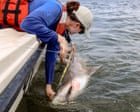
While anglers cannot take endangered sand tiger sharks, a loophole lets private firms catch the fish to sell abroad, profiting from Delaware Bay’s conservation success
Shortly after 12.45pm, what remains of a 300-metre line goes taut. Somewhere beneath the murky green surface of Delaware Bay, on the eastern US coast, a sand tiger shark has taken the bait of a mackerel chunk. Marine researchers at the University of Delaware haul the line towards a small boat as the shark’s grey-brown outline emerges.
It is a large animal: 225cm (7ft) long with a 90cm girth. Its mouth hangs open, revealing rows of jagged teeth. The researchers work quickly, measuring the shark, recording its sex, and taking blood and muscle samples. A tag is then fastened beneath its dorsal fin, through its thick sandpapery skin.